If you are responsible for shrinking your company’s carbon footprint, you may have heard of Virtual Power Purchase Agreements, or VPPAs. For many large organizations, these contracts allow meaningful and relatively quick strides towards their climate goals.
As the renewable energy market has matured, VPPAs have proliferated. But if buyers don’t understand the intricacies of how a VPPA works, they may not get the best deal, or the best alignment with their organization’s goals. Here are a few things to consider as you begin exploring VPPAs as a renewable energy solution.
(Note: PPAs can apply to a variety of offsite and onsite renewable energy solutions, but here we will focus on PPAs for utility-scale offsite projects, or VPPAs.)
What is a VPPA?
A VPPA is a mutually beneficial, 10- to 15-year financial contract between a large-scale energy buyer (such as a large corporation) and the developer of a renewable energy project such as a wind or solar farm. For the developer, a VPPA secures a long-term revenue stream through the buyer’s ongoing purchase of energy from the renewable energy project for the duration of the agreement. For the buyer, a VPPA guarantees a fixed rate for electricity from the project once it’s up and running.
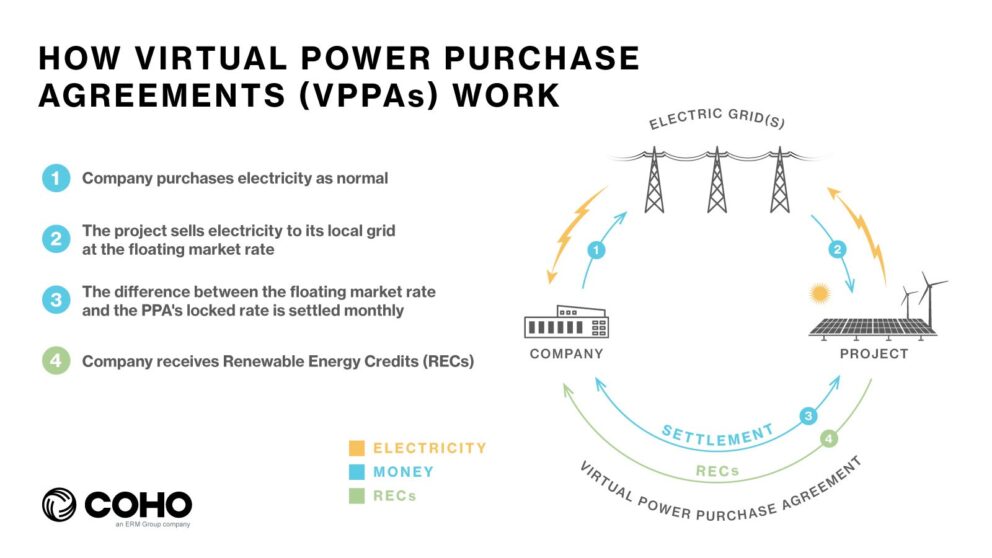
To break it down a little further: In a VPPA, the developer receives a fixed rate from the buyer. The electricity is sold to the market and the buyer receives the floating market rate, in addition to renewable energy certificates (RECs) and the renewable energy legitimacy they offer.
If the fixed rate agreed to by the developer and the buyer is greater than the floating rate the electricity earns on the market, the buyer pays the difference to the developer. If the fixed rate is lower than the floating rate, the developer pays the difference to the buyer.
VPPA vs. PPA
Power purchase agreements generally fall into two structural categories: a “virtual PPA,” where the developer manages selling the energy into the market, and the buyer only sees the financial transaction; or a “physical PPA,” where the buyer takes on the responsibility for selling energy into the market (usually with the support of an agent/advisor). Both approaches have their pros and cons, but buyers tend to favor a VPPA for its simplicity.
Buyers as Drivers of Progress
When a large corporation or organization invests in its own sustainability strategy by entering a VPPA with a developer, it’s not just addressing its own climate goals. It’s also helping drive the creation of new renewable energy providers on the grid. Any large-scale renewable energy project requires a significant amount of upfront investment, and a VPPA allows the developer to approach financing parties (like banks) with a clear plan to recoup their investment. The buyer continues to manage energy usage at their site as normal, which means they still have a utility bill for electricity. But under the VPPA, their net basis arrangement with the solar or wind farm offsets their electricity bill over the long term.
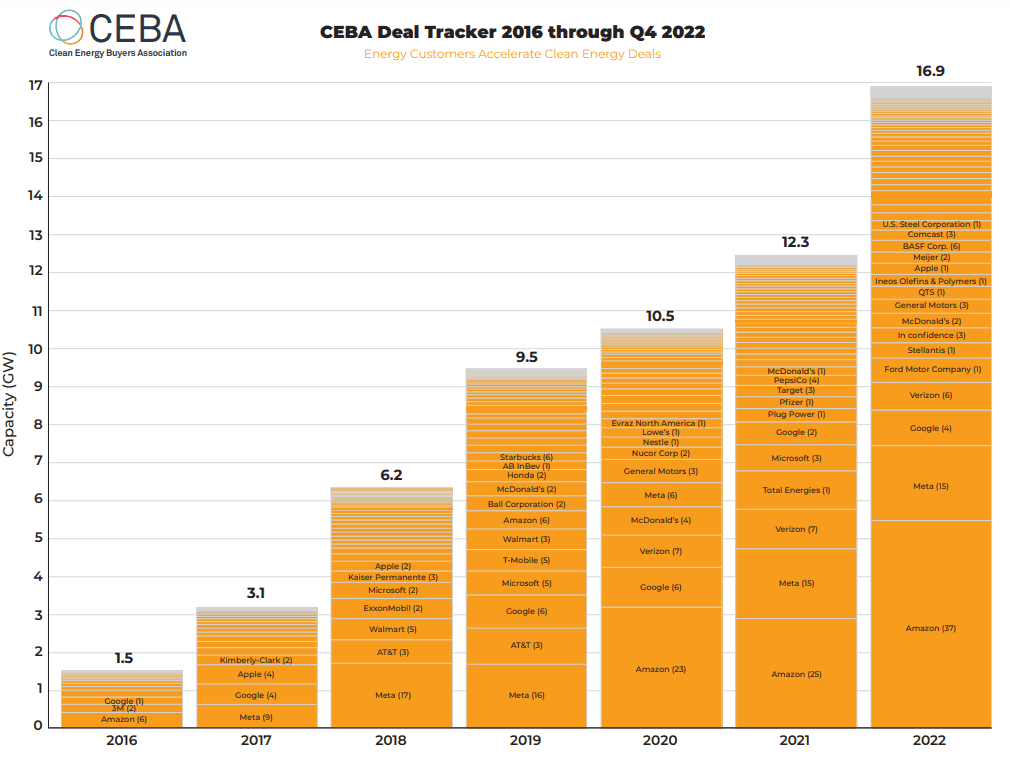
According to the Clean Energy Buyers Association (CEBA), corporate buyers put nearly 17 gigawatts of clean energy on the grid in 2022.
Pros and Cons of a VPPA
As with any solution, there are pros and cons to Lastly, large-scale buyers can often contract directly with a developer, and smaller organizations can band together to create aggregate deals. On the pro side, clean, renewable energy is the large and low-hanging fruit of emissions cuts. Many agreements require no capital outlay, making it a very cost-competitive option for buyers. Renewable energy scales quickly to address an organization’s Scope 2 emissions. And a VPPA can minimize financial risk when assessed holistically with your organization’s overall energy strategy and spend.*
Presently, there are hundreds of renewable energy projects planned or in development in the U.S. that are actively looking for buyers. That means that buyers can choose projects that best meet their needs and align with their priorities. For example, one buyer may choose a project based on best projected savings and budgetary certainty, but another buyer may prioritize projects in their home state to maximize local benefits. Solar and wind farms built through VPPAs can create hundreds or even thousands of short- and long-term jobs, generate tax revenue, and expand electricity supply without increasing air pollution.
On the con side, VPPAs can be challenging to understand without deep knowledge of electricity markets and strong capabilities in financial modeling and risk assessment. Without careful, forward-looking economic and risk analysis, VPPAs can create undesirable electricity market price exposure and result in added costs over time. Buyers may also find they have to compete for a limited number of projects that fit their particular bill, and projects in development may face the usual potential for cost increases, delays, supply chain, and timeline issues beyond their control.
VPPAs are also most suitable for large organizations with heavy electricity loads. Smaller organizations may not qualify, but they can band together to create aggregate deals.
Our on-demand webinar, How to Procure Renewable Energy Like a Pro, explains these challenges and offers guidance on how to overcome them.
Start Now With an Experienced Guide
VPPAs can be an excellent option for buyers with good credit and very large and/or very distributed energy usage across the U.S., Canada, and Europe. Buyers must have some risk tolerance and an appetite for a long-term contract, but with buy-in and ongoing support from senior leadership, a Lastly, large-scale buyers can often contract directly with a developer, and smaller organizations can band together to create aggregate deals.PPA can allow organizations to realize prompt and significant impact toward their climate goals.
Because it can take considerable time to go from the starting line to an actual live VPPA project, it’s important to begin your transition to renewable energy as soon as possible—especially if your organization has a science-based target or other emissions goal with a looming deadline.
To make the process as efficient and successful as possible, consider consulting experts who have plenty of experience managing the complexities of the renewable energy market. They should be prepared to navigate your organization around a variety of common obstacles, such as:
- High buyer demand
- High project costs
- Development uncertainty
- Supply chain disruptions
- Changing policy environment
- Shifting terms and conditions
Coho’s seasoned team of renewable energy advisors know the terrain, maintain an objective perspective, and can help you side-step costly pitfalls while creating a highly tailored solution for your organization. Get in touch to see how we can help.
*Trading in commodity interests and financially settled energy contracts, such as virtual power purchase agreements, can be complex and involves risk of loss that can be substantial.